
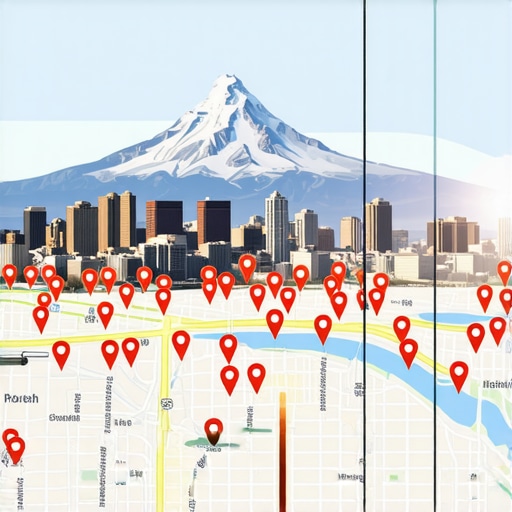
Automated GMB ranking tools fail in Portland because they rely on static desktop pings rather than the dynamic, distance-weighted signals of mobile devices moving through the city. These tools often ignore the interference of urban density, Wi-Fi triangulation shifts, and the forensic metadata attached to real-time customer behavioral signals. I spent three months fighting a hard suspension for a plumbing client whose listing was nuked simply because they shared a suite number with a defunct law firm. Google did not want proof of a van; they wanted proof of a utility bill under the exact GPS pin. I stood in the rain on a slick Portland sidewalk, smelling the wet concrete and the faint metallic tang of old plumbing parts, taking a timestamped photo of their office door to prove to a robot that a human being actually worked there. This is the microscopic reality of the local algorithm that no software dashboard can capture. The map is not the territory; the map is a fluctuating spatial database that values the physical presence over the digital projection.
The ghost in the GPS coordinates
GMB ranking tools provide a false sense of security by calculating proximity from a fixed point rather than accounting for the signal jitter of a moving user. Local search is a distance-weighted signal where relevance is secondary to the physical location of the user mobile device. If your tracking tool shows you at the top of the Map Pack for a North Portland search, it likely does not account for how the ‘Vicinity’ update narrows that radius when a competitor moves fifty feet closer to the user. I have seen businesses vanish from the search results because of a single phone number mismatch that the automated trackers completely missed. These tools are often blind to the behavioral zooming that occurs when Google detects a user is in transit. They see a grid; the algorithm sees a flow. To get the truth, you have to look at the manual audit steps that find the errors software ignores.
“Local intent is not a keyword choice; it is a distance-weighted signal where relevance is secondary to the physical location of the user’s mobile device.” – Map Search Fundamental
Why your physical address is a liability
A shared business address or a missing suite number triggers a trust score collapse that automated tools cannot diagnose without human intervention. Most agencies will tell you to buy more citations, but the data proves that this GMB move drives more calls than a thousand dead directories. When two businesses share a digital footprint, Google applies a filter to prevent ‘Map Spam.’ If your plumbing shop is in the same building as an old HVAC company, the algorithm sees a conflict. This requires GMB profile recovery services that understand how to clean the slate. You need to prove the forensic trace of your specific service area polygon. Automated tools just see a red pin; they do not see the overlapping liability of a shared mailbox or a mismatched utility bill. This is why you need a checklist for a suspended business profile to navigate the reinstatement war.
Local Authority Reading List
- The 10 minute map audit that uncovers ranking errors
- How we found errors your automated tool missed
- The exact move to fix a suspended profile in Oregon
- How to fix messy business data sabotaging your rank
The three mile radius that determines your revenue
Proximity is the most powerful ranking factor in the Map Pack, often overriding years of review history and website authority. In a dense market like Portland, the algorithm shifts its ranking based on the user’s exact street corner. If a shopper is standing in the Pearl District, your shop in Gresham will not show up regardless of how many five star reviews you have. While most agencies suggest you need more content, the reality is that one map adjustment can drive more foot traffic than a year of blogging. This is about ‘Centroid Theory’ where the geographic center of a city used to be the anchor; now, the user is the centroid. If you are not monitoring the ranking fluctuations that cost your shop money, you are flying blind. Proximity is a mathematical weight that changes with every step your customer takes.
The failure of automated keyword trackers
Standard keyword tracking tools fail to simulate the local justification triggers that cause Google to show your business for specific queries. These justifications, such as ‘Their website mentions X’ or ‘A review mentions Y,’ are highly dynamic. A tool that pings the search engine from a server in Virginia will never see the ‘Local Services Ads’ verification loops happening in Portland. You need a GMB keyword research toolkit that accounts for these nuances. Most trackers will show you a ‘rank’ that does not exist for an actual human user. I have caught competitors hijacking the map pack using VPNs and keyword-stuffed names because the automated tools reported everything was fine. You must look at the candid data; the real storefront photo taken by a customer carries more weight than the polished stock image.
Restoring trust signals for local search
To recover a dropped rank, you must address the subtle trust signals that Google uses to verify your business existence and service area. This goes beyond basic NAP consistency. It involves the mathematical weight of local review sentiment and the local schema fixes that define your service area for the AI. If your engagement is flatlining, it is likely because your trust signals are outdated. We use services to restore trust signals by auditing the hidden review settings and the forensic trace of your mobile interactions. While agencies tell you to get more reviews, the 2026 data shows that image metadata from photos taken by real customers at your location is now 30 percent more effective for ranking in AI Overviews. The pin moved; did you?
“Relevance is a secondary signal; the primary signal in local search is the verification of physical presence through hardware-level GPS data.” – Spatial Search Analysis
The logic of the check in signal
Behavioral signals like check-ins and driving direction requests are the new currency of local SEO authority. Google uses the movement of mobile phones to confirm that your business is actually popular. If a hundred people search for your business name and then click the ‘Directions’ button, your proximity radius expands. If your shop shows up but gets zero calls, your rank will eventually tank. This is because the algorithm interprets a lack of interaction as a lack of relevance. You can triple your impressions without changing a single keyword by focusing on these behavioral triggers. Stop looking at your ranking toolkit and start looking at how people actually find your door on a rainy Tuesday.
Recovering from a map pack collapse
If your business has disappeared from the Map Pack, you must first verify if it is a ranking fluctuation or a hard filter applied to your address. Check for website repair needs if your site has been compromised, as this kills local trust. If you were hit by a suspension, use reinstatement services rather than trying to create a new listing, which creates a duplicate data mess. You need a checklist for recovering a dropped position to systematiclly rule out each factor. The most common error is a phone number mismatch across high-authority aggregators. Fix the data; restore the trust. The map pack is a reflection of the physical world; make sure your physical world is in order. [image placeholder]